1. The Document at a Glance
Action Plan for Stabilising Growth in the Electronic Information Manufacturing Industry, 2025–2026
The plan positions electronic information manufacturing as a strategic, foundational and leading industry for the national economy, and as a key area for keeping industrial growth stable. It sets out 16 tasks across three fronts: improving supply, expanding demand and strengthening innovation.
2. Three Numbers to Start With
| Target | Requirement |
|---|---|
| Value added of computer, communications and other electronic equipment manufacturing above designated size | Average growth of around 7% |
| Average annual revenue growth once lithium battery, PV and component manufacturing are included | Above 5% |
| By 2026 | Revenue scale and export share to remain first among the 41 industrial categories; five provinces to exceed one trillion yuan in revenue; server industry above 400 billion yuan; domestic penetration of 75-inch and larger televisions above 40% |
One detail deserves attention: the document brings component manufacturing into the revenue calculation as a separate line. That places electronic components on the same footing as finished equipment and confirms their foundational role. They are no longer treated merely as a supplier input to an assembled product.
3. Three Clauses That Matter Most to Components and Audio
Strengthen upstream and downstream coordination
The clause sits under industrial transformation and upgrading, alongside moves to push finished electronic products up the value chain, optimise industrial layout and improve standardisation.
For small and mid-sized component and audio manufacturers the signal is direct: the space for going it alone is narrowing. Joining the supply chain of an equipment maker or a systems integrator is the more reliable route to orders and to technical feedback.
Develop new business models and strengthen application enablement — education named
The plan calls for selecting and promoting a set of representative solutions addressing demand in industry, culture and tourism, education, health and smart cities.
This is the sentence closest to classroom audio. Education is no longer a generic reference to an end market; it is named as a priority scenario where solutions are to be selected and promoted. For companies that can deliver product, engineering and commissioning as one package, this amounts to policy recognition of the shift from selling equipment to delivering solutions.
Tiered enterprise development and tax support
The plan asks for a tiered development pipeline covering high-tech enterprises, technology-based SMEs, gazelle enterprises and unicorns, supports eligible electronics manufacturers in obtaining high-tech status, and calls for the associated tax incentives to be delivered.
It also states that SMEs should be encouraged to focus on niche segments and differentiate, and that "involution-style" competition should be addressed, with below-cost pricing tackled according to law.
4. What It Means for the Classroom Audio Sector
Set the 16 tasks against the day-to-day business of classroom audio and three shifts become visible.
From comparing unit prices to comparing solutions and references
With education named as a priority application area, local authorities pushing smart campus programmes and classroom acoustics retrofits are more likely to favour suppliers with a standardised solution and a track record of delivered projects, rather than judging on a single unit price.
The room for price wars is narrowing
Cracking down on involutionary competition and encouraging SMEs to specialise appear in the same document. Competing by stripping out content and cutting price becomes harder to sustain, while firms that commit to one technology route and go deep on it gain ground.
Supply chain coordination becomes a hard capability
Upstream and downstream coordination is written into the task list, which means components, finished equipment and systems integration will work more closely together. SMEs able to coordinate across that chain have a defined position in the chain-leader plus supplier model.
5. How Haixin Responds
Against that policy direction, Haixin has built a complete matrix along the infrared route.
| Model | Product | Core capability |
|---|---|---|
| IR-5000M | All-in-one infrared amplifier | 2×150W into 4–8Ω, dual-frequency auto-avoidance at 2.06/2.56MHz, up to 4 infrared sensors, 100 m cable runs, USB recording, Type-C input and RS232 control |
| IR-230MD | All-in-one infrared teaching amplifier | 2×30W/50W dual channel with DSP feedback suppression, no howling with the microphone a metre from the loudspeaker, 25V/70V/100V broadcast input for campus paging integration |
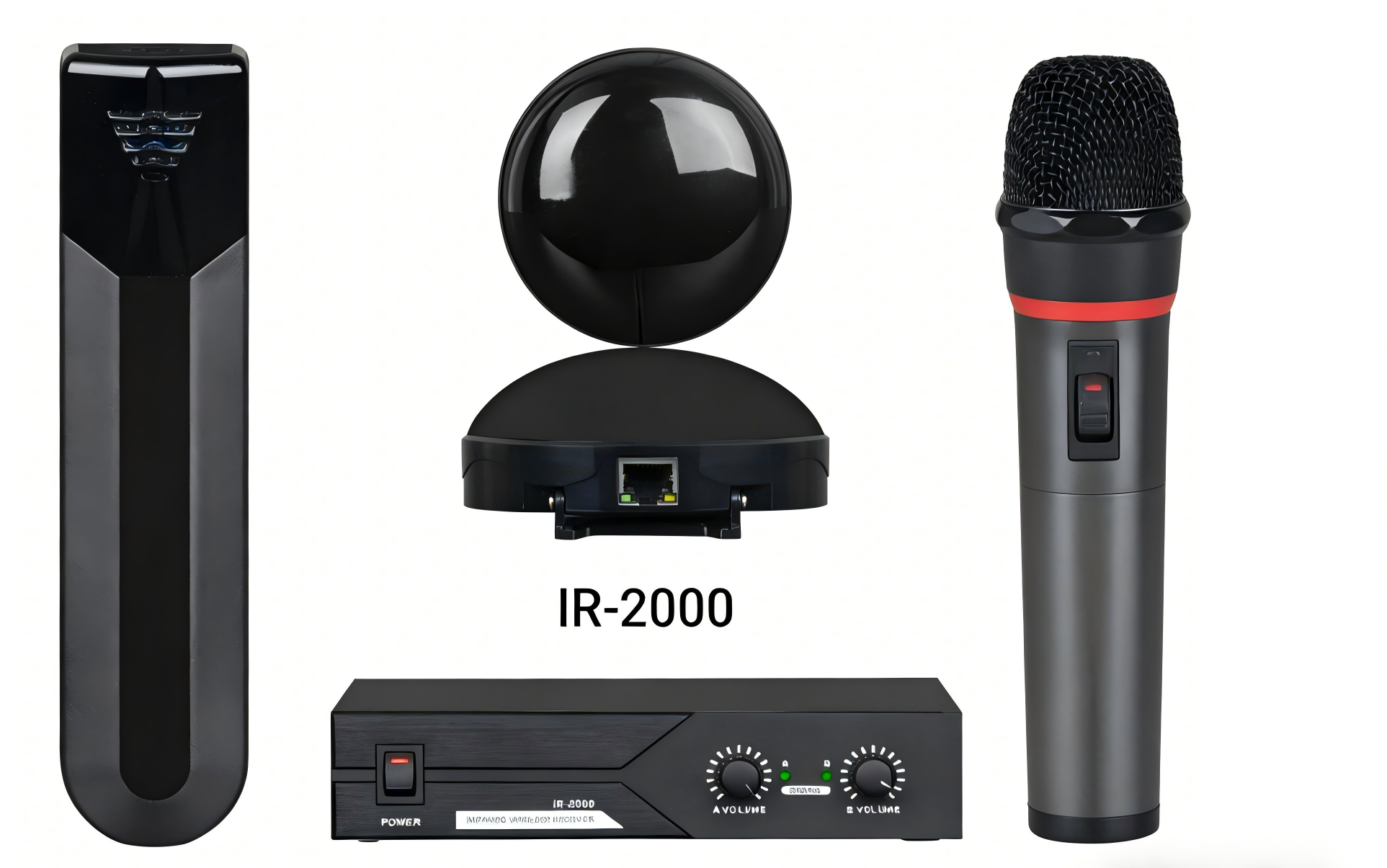
| IR-2000 | Dual-channel infrared wireless receiver | Automatic 2.06/2.56MHz selection, Cat5e runs up to 100 m, 850nm wavelength, no RF radiation |
| IR-300H + CD-4 | Professional infrared handheld microphone with four-channel dock | 850nm transmission, A/B dual channel against crosstalk; the CD-4 delivers a 2.5 h charge and 6 h runtime, with four independent channels and Type-C 65W input |
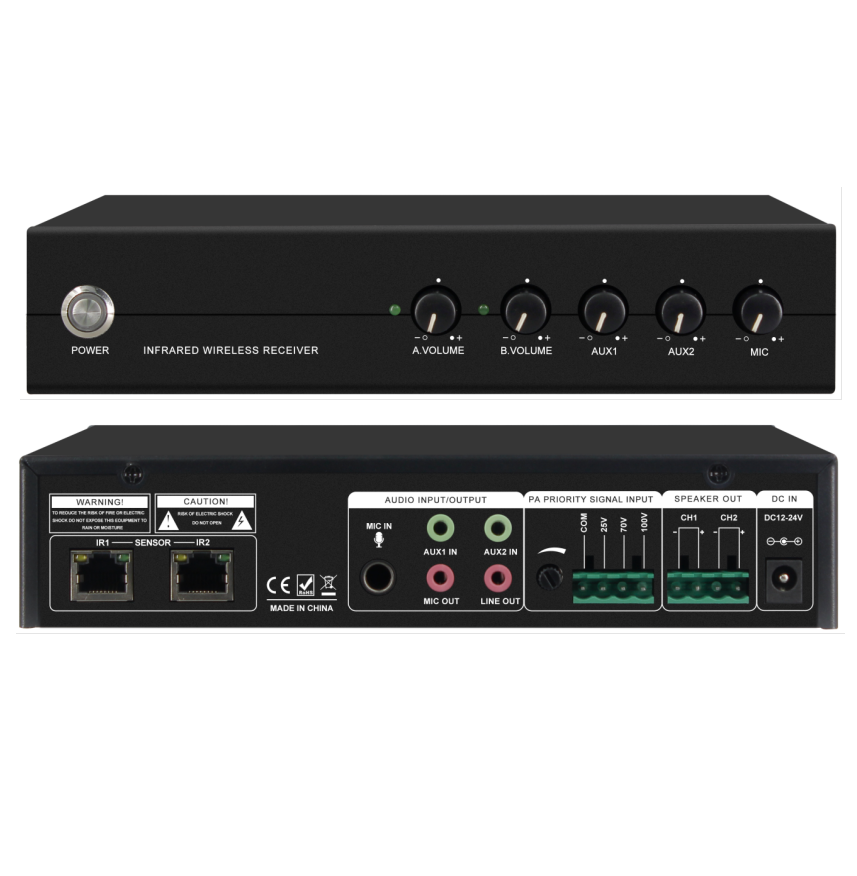
That scalability is precisely the solution capability the policy is pointing at. From two-channel audio in a single room to a whole floor sharing one amplifier with sensors zoned across rooms, the same technical foundation applies, which makes it practical to plan a whole-school retrofit and deliver it in phases.
6. A Closing Note
Industrial policy of this kind rarely proves itself on the day it is published. It shows up in the following two years, in the detail of local implementing rules and procurement standards. For classroom audio suppliers, the useful move is not to wait for those rules before adjusting, but to put solution capability, project references and standardisation in place first.