1. The Real Problem Is Not Volume, It Is the Teacher Being Drained
Most classroom audio retrofits begin with a very ordinary complaint: teaching is exhausting for the voice. Unpack that sentence and three interlocking problems sit behind it.
To make sure the back row hears, the teacher keeps raising the voice. By the end of a lesson the vocal cords are fatigued, and over a term this becomes chronic laryngitis.
Insufficient sound pressure drops attention in the back rows, which forces the teacher to shout harder, which feeds the cycle again.
Gain is turned down to suppress feedback howling, so the volume never gets high enough. Turn it up and the howling returns.
In other words, voice strain is not a habit the teacher needs to break. It is a symptom of a sound reinforcement system that leaves no headroom for transmission gain. The point of the retrofit is to give that headroom back.
2. Why Conventional Wireless Struggles in Classrooms
A classroom is a dense, close-range, many-rooms-in-a-row environment. Adjacent rooms sit one wall apart, and several wireless microphone systems run at once. Two kinds of trouble follow.
- Co-channel and adjacent-channel interference. Radio signals travel through walls, so a microphone in the next room can be picked up here as crosstalk or breakthrough.
- Ambient electromagnetic noise. Multimedia equipment, LED lighting and switching power supplies all raise the noise floor and squeeze the usable channels.
There is a hidden management cost as well. Every room's frequency has to be planned, logged and coordinated, and any new device or one-off event means re-planning the whole set.
3. Design: IR-230MD With Four Zoned Infrared Sensors
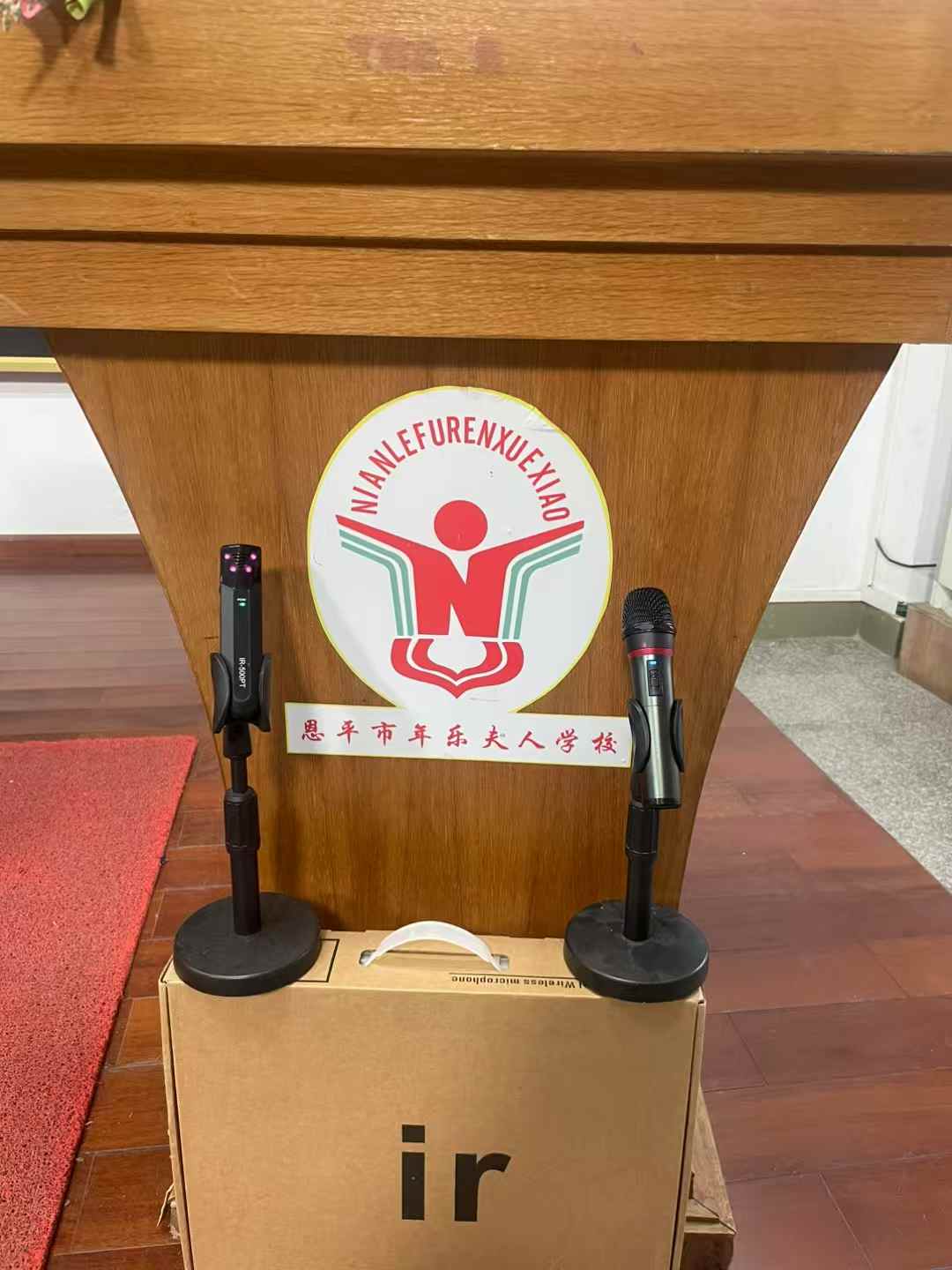
The project replaced radio-frequency wireless with infrared transmission. Infrared travels as light inside the room, and its physics mean it does not pass through walls and does not occupy a radio band. That is the key to solving crosstalk.
The system has three parts.
- IR-230MD all-in-one infrared teaching amplifier. Infrared reception, mixing and power amplification are integrated into a single unit, cutting the number of devices in the cabinet and the number of cable joints, and with them the number of failure points.
- Four infrared sensors per room. Each classroom was fitted with four sensors arranged for overlapping coverage, so the signal stays continuous as the teacher moves around the teaching area, without dropouts or dead spots.
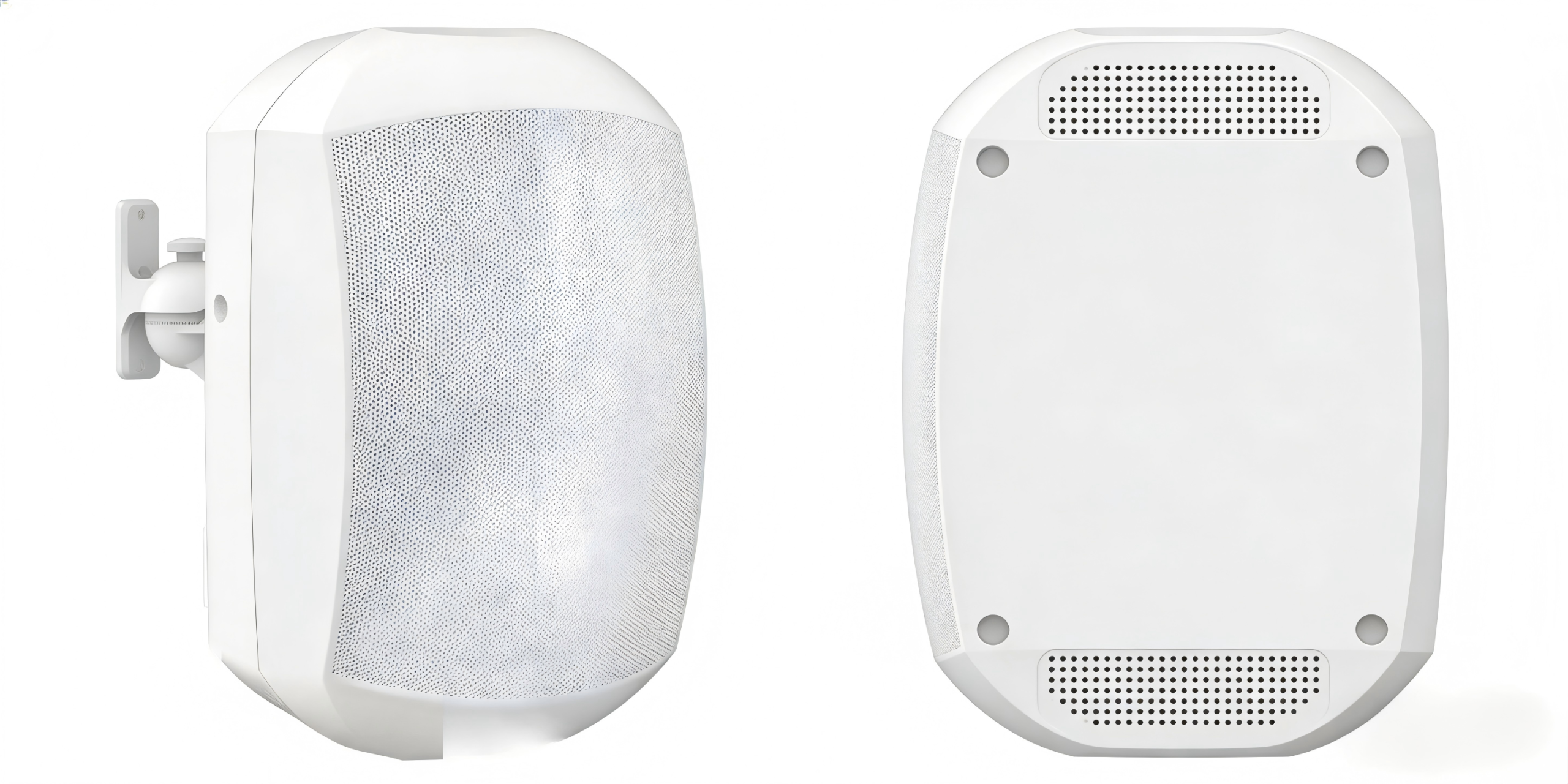
- Zoned loudspeaker outputs. The amplifier supports multiple loudspeaker zones, so speakers can be allocated to suit each room's acoustics and no single point runs at a sound pressure high enough to trigger howling.
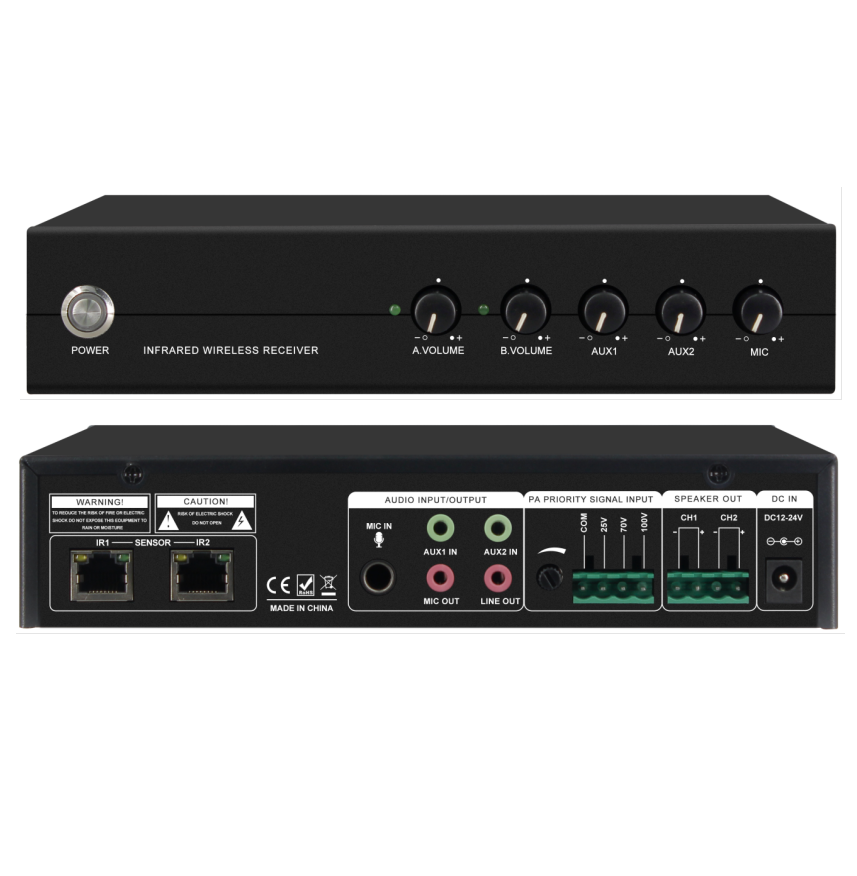
The integrated approach also pays off in maintenance. Equipment is concentrated in the podium cabinet, faults are easy to locate, and daily checks come down to sensor orientation and microphone batteries. There is no frequency ledger to maintain.

4. Deployment: Seventy Percent of the Result Is in the Installation
Infrared sound reinforcement is not a fit-and-forget technology. The details below decide the outcome.
- Sensor position. Mount at the centre of the ceiling or above and in front of the podium, facing the teacher's main working area. Keep away from direct sunlight through windows and from projection screen reflections, since strong light compresses the infrared receiving dynamic range.
- Overlapping coverage. Leave a modest overlap between the four sensors so that walking, writing on the board and stepping down among the students never loses the signal.
- Clear line of sight. Ceiling projectors, lighting trusses and ceiling fans must not block the path between sensor and microphone.
- Gain and placement. Set microphone sensitivity and amplifier gain in steps. Keep loudspeakers forward and facing the students, never directly facing the podium.
- Cabling and power. Run signal and power cabling separately to reduce interference, and leave ventilation space in the cabinet.
5. The Result: No Howling at One Metre
After commissioning, the system was measured on site. With the teacher wearing the microphone and walking to one metre from the loudspeaker, no howling occurred. That means the teacher can move freely between the podium, the board and the students without worrying that approaching a speaker will set off a squeal.
Normal teaching volume
The teacher speaks at an ordinary level and vocal strain drops noticeably. No more shouting.
Better back-row hearing
The teacher no longer has to keep asking whether the back of the room can hear.
No crosstalk
Infrared does not pass through walls, so adjacent rooms and even adjacent floors do not affect each other.
6. Acceptance and the School's Feedback
Installation, commissioning and teacher training across the twelve rooms were completed within five days, followed by an acceptance inspection organised by the school. The inspection covered the howling threshold distance in each room, continuity of hearing while walking, a crosstalk check between adjacent rooms, and power-off and restart recovery tests.
- Howling threshold distance measured room by room
- Continuity of hearing while the teacher walks the room
- Crosstalk check between adjacent classrooms
- Power-off and restart recovery test
The equipment was installed properly and commissioned carefully. Teachers report that they can now teach at a normal volume without shouting, and that their voices feel much better by the end of the day. Students at the back hear more clearly too. There has been no crosstalk between neighbouring classrooms. The overall result meets expectations.
7. Where Infrared Classroom Audio Fits
Based on this project, the infrared approach suits the following situations particularly well.
- Primary and secondary teaching buildings where classrooms are densely packed and separated by a single wall.
- Sites with confidentiality requirements, since the infrared signal never leaves the room and provides spatial isolation by design.
- Schools without the staff to plan frequencies or maintain a dedicated AV support team.
- Retrofit projects where an existing system howls frequently and teachers complain of voice strain.
Where the space is large, heavily partitioned, or has extensive glass curtain walls, a dedicated acoustic and infrared coverage survey is needed at design stage. Standard configurations should not simply be applied.