
1. The KTV Problem Was Never Just About Sound Quality
A KTV venue is a dense, close-quarters, many-rooms-in-a-row environment. A corridor has a dozen rooms on each side, every one of them running microphones at the same time. In that setting, what actually damages the guest experience and the operator's day is usually three much more basic things.
- Crosstalk between rooms. Radio-frequency wireless travels through walls. A microphone in the next room can be picked up by the receiver in yours, and just as a guest reaches the high note something else cuts in, or a burst of noise does. The evening is over.
- Battery and charging management. A dead microphone is one of the most frequent operational failures in a KTV. Staff judge charge level by eye, put half-charged and fully-charged units back into rooms together, and only discover the problem at the next switch-on.
- Turnaround and hygiene. One microphone passes through several groups of guests in a night. Without a fixed routine for issuing, cleaning and returning them, both the hygiene impression and the loss rate suffer.
What these three share is that none of them is a question of whether a device is broken. They are questions of how stable and how manageable the system is under dense conditions. That is precisely where the IR-300H and the CD-4 are aimed.
2. Why Infrared Suits KTV: Light Does Not Leave the Room
Infrared carries audio as light through the space, and its physical behaviour means it does not pass through walls and does not occupy a radio band. In a KTV that property is worth more than it is in a meeting room or a classroom.
- Rooms are isolated by default. The signal is stopped by the wall, so the microphone next door never arrives in your room, and there is no frequency plan to draw up for each room.
- No sensitivity to the electrical environment. A KTV room is full of karaoke terminals, televisions, LED strips and Wi-Fi. Those raise the noise floor and squeeze the usable channels out of an RF system. Infrared is unaffected by any of them.
- No frequency management. The venue does not need to maintain a channel ledger, and adding a room or a spare microphone does not require coordinating an avoidance plan.
- Privacy comes built in. The signal stays inside the room, which is a genuine extra for venues that host business guests.
Infrared does depend on line of sight: there must be a visible path between microphone and receiver. In practice, where the receiver is mounted and which way it faces will decide the result more than the specification sheet does.
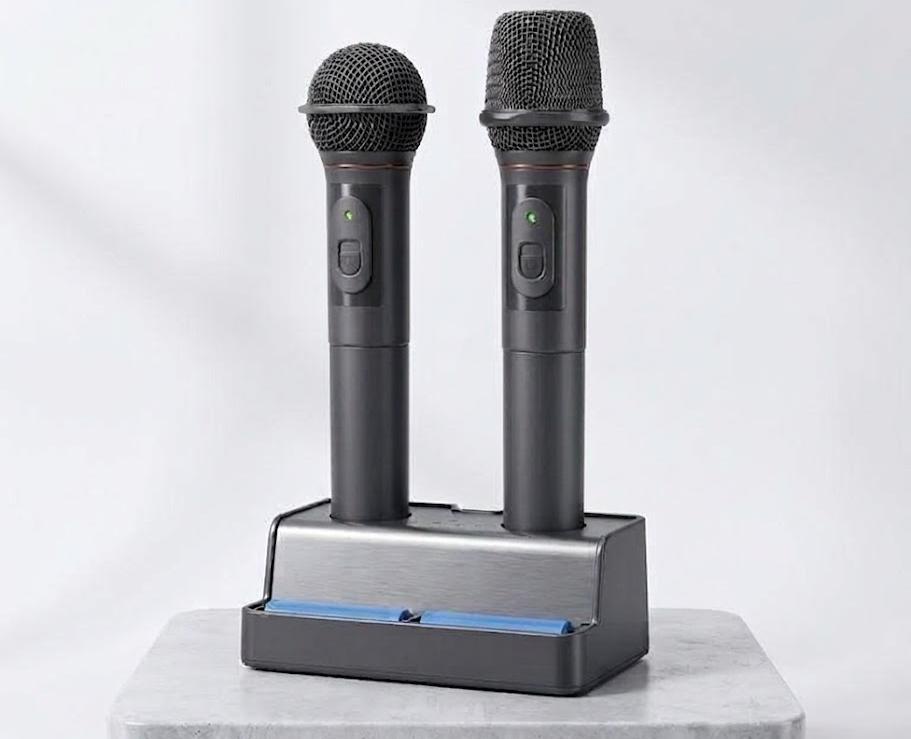
3. IR-300H: An 850nm Infrared Handheld Built for Handheld Singing
The IR-300H is an infrared handheld microphone using 850nm transmission. Handheld is the dominant form in a KTV: guests grip it, sing from close in, stand up, walk around. Those habits place different demands on pickup stability and on how the body feels in the hand than a lavalier or headset in a classroom or a conference room.
Three points on positioning
- Fit for purpose. Designed for KTV rooms, chain karaoke venues and bar booths, rather than being a general-purpose microphone asked to do everything.
- System compatibility. Works alongside the IR-2000 and IR-5000M, so a venue that already runs an infrared system can add microphones without replacing the host equipment.
- Delivered as a pair with the CD-4. Microphone and dock are treated as one working unit, so storage, charging and return form a closed loop rather than three unrelated habits.
4. CD-4: Turning Battery Management from Guesswork into a Process
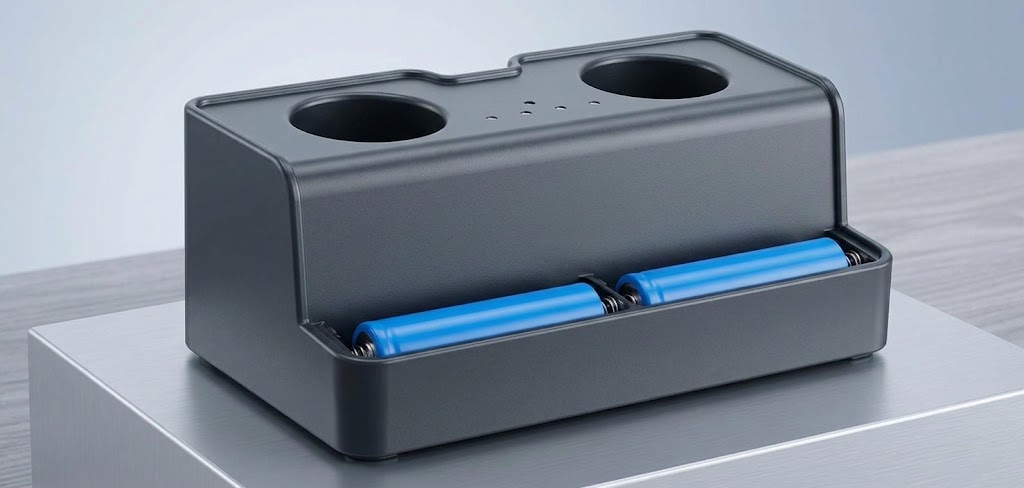
If the IR-300H answers "will it hold up while they sing", the CD-4 answers "will it still have power". The CD-4 is a four-channel charging dock that charges four microphones at once, pulling charging out of wherever it happened to happen and into one fixed location.
What it changes is the way the venue works
- Centralised charging. Four channels topping up at once, one dock per microphone set, one power point and one place to put it at the front desk or in the equipment room.
- Returning is charging. Putting the microphone back and topping it up become a single action, which removes the "thought it was full" failure.
- A visible ledger. One set maps to one dock. Which set is short a unit, which microphone never came back, is obvious at a glance, and loss rates drop.
- Faster turnaround. At shift change the whole set rotates together instead of each unit being judged individually, so rooms wait less time for a microphone.
5. How the Three Products Fit Together
The IR-300H and the CD-4 are not standalone items. Their point is to take the capability the IR-2000 and IR-5000M already have and complete it to the level where a whole venue can be handed over as one package.
| Product | Role in the KTV deployment |
|---|---|
| IR-2000 | Infrared reception and the main audio link inside the room |
| IR-5000M | Higher-power amplification where the room or the sound design demands it |
| IR-300H | Fills in the handheld form, the shape guests actually sing into |
| CD-4 | Fills in charging and storage, so the package stops at "can be installed" and reaches "can be managed" |
For a contractor this means one infrared system can cover venues of quite different sizes. A small venue sizes microphones and docks to its room count. A large venue or a chain groups them by floor or by zone. Microphones and docks flex up and down with the room count, without changing the host system underneath.
6. Deployment: In KTV, Infrared Lives or Dies on Installation
Because infrared depends on line of sight, the details below decide whether guests ever hit a dropout or a dead spot.
- Receiver orientation. Mount inside the room facing the seating and singing area so that guests are covered both standing and seated.
- Avoid strong light and reflections. Keep the receiver away from spotlights, LED strips and large mirrors or glass. Strong light and reflections compress the receiving dynamic range.
- Keep the path clear. Televisions, karaoke screens and suspended lighting trusses must not sit between microphone and receiver.
- Separate the rooms. Do not mount receivers in adjacent rooms face to face, otherwise the doorway and corridor become a cross-coverage zone.
- Zone the outputs and set the gain. Configure loudspeaker zones and gain per room acoustic so that howling is controlled without giving up volume.
- Place the dock deliberately. Put the CD-4 at the front desk or in the equipment room, near power and where shift handover can count it, not loose inside a room where it will be moved.
7. The Four Questions Venues Ask Most
1Will it bleed into the room next door?
Infrared does not pass through walls, and that is the essential difference from RF. As long as receivers are placed per room and adjacent rooms are not cross-covered, crosstalk does not occur.
2What if a guest runs out of power mid-song?
The answer is not how long one microphone lasts, but whether the venue has a rotation routine. With the CD-4 configured and rotated by set, the units in use and the units on charge stay separate, which is more reliable than chasing a longer runtime figure.
3We already run an IR-2000 or IR-5000M. Can we just add these?
The IR-300H works alongside both. The exact mixing arrangement and the maximum number per host unit should be confirmed by Haixin technical staff against the installed model and the room layout.
4How many microphones and docks per room?
It depends on room capacity, whether duets are common, and the venue's microphone rotation policy. The usual approach is to size to the room's microphone count and keep one spare set in rotation.