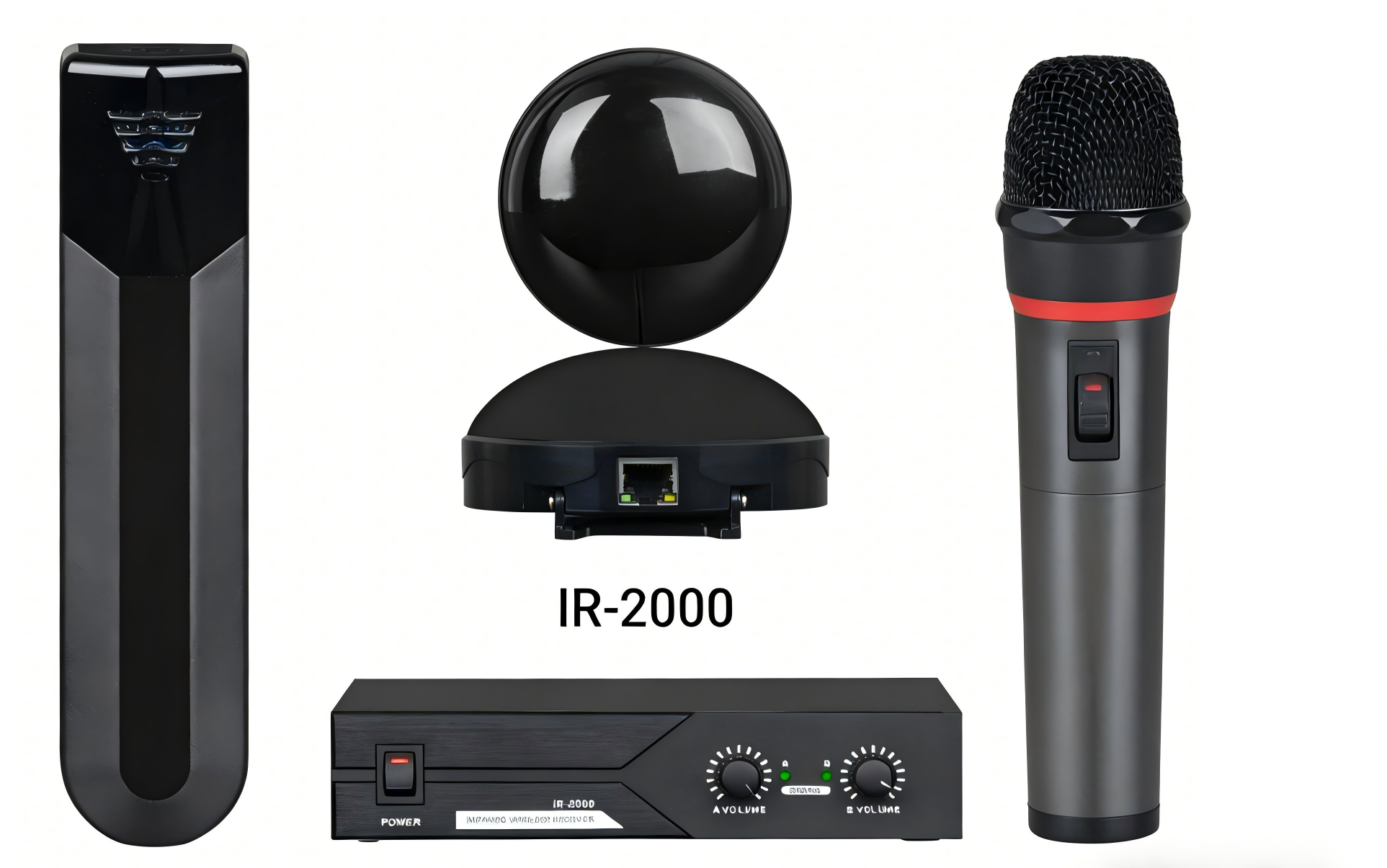
Infrared teaching amplifier systems finally changed that. What is now treated as standard equipment in a smart classroom did not arrive in one step. It went through four stages, each one solving the problem the previous stage left behind, and each one exposing a limitation of its own. Read them in sequence and it becomes clear why classroom audio ended up on infrared.
Before Infrared: Tied to a Cable, Then Trapped by Crosstalk
Before infrared reached schools, classroom amplification went through a few uncomfortable phases.
The wired microphone era
The earliest classroom amplification was a microphone on the podium, tethered by a cable. The teacher was anchored to the front of the room and could not step down to work with students, which limited how the lesson could be taught.
The wireless RF era (VHF / UHF)
Wireless microphones arrived and teachers were finally free to move — but crosstalk came with them. Radio waves pass through walls, so neighbouring classrooms interfered with each other constantly. Schools had to draw up frequency allocations before every term, and once the channels drifted, the amplification on a whole floor descended into chaos.

Analogue Infrared: A Natural Boundary
To solve crosstalk properly, engineers turned to infrared. Classroom amplification entered its first infrared phase.
Infrared travels in a straight line and does not pass through walls. Close the classroom door and each room becomes its own self-contained audio space.
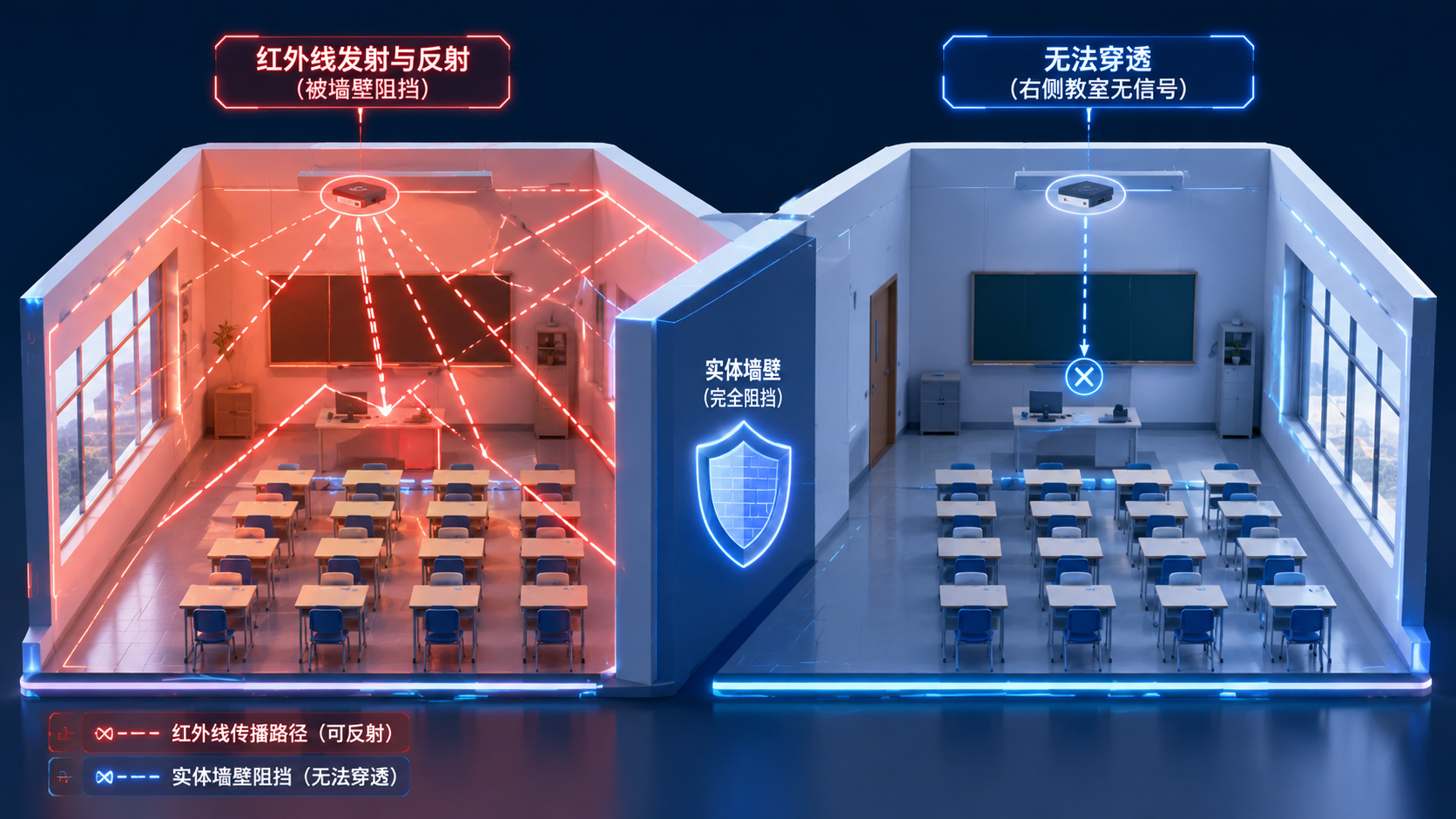
Crosstalk ended
However many classrooms a school has, an infrared microphone cannot interfere with the room next door.
One teacher, one microphone — no pairing, switch on and use
A teacher simply owns their own infrared microphone and can walk into any classroom with an infrared receiver panel and use it immediately. It is more hygienic, and it removes a great deal of administrative work.
Digital Infrared: A Step Change in Sound Quality
As digital chips became affordable, infrared teaching amplifiers moved from analogue to digital. This is the stage most modern schools currently operate.
High-fidelity sound
Digital modulation schemes such as DQPSK remove most of the noise floor and environmental interference, and reproduce the voice far more faithfully. Teachers sound natural rather than forced, and students can listen for a full lesson without fatigue.
Multi-channel without interference
Digital infrared systems carry multiple channels, so two or more microphones can work in one room at once. A teacher wears a lavalier while students pass a handheld around to answer, and neither interferes with the other.
Much lighter hardware
Early microphones were as heavy as a walkie-talkie. Digital infrared units are built as pendants or clip-ons weighing a few tens of grams, light enough that a teacher forgets they are wearing one.
The Connected Era: From Amplifier to Network Node
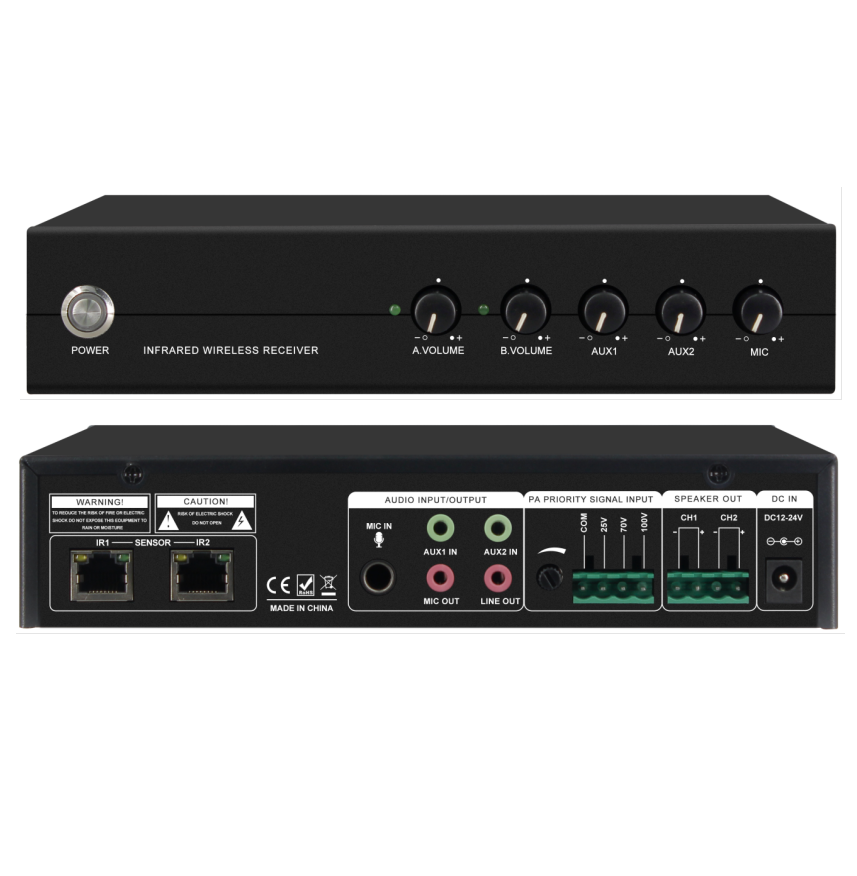
Today's infrared teaching amplifier is no longer simply an amplifier. It has become a node on the classroom network.

Noise processing
Recent amplifiers carry on-board audio processing that filters out fans, air conditioning and page turning, keeping as much of the voice as possible.
Deep integration
Where the amplifier used to be a heavy metal box, it is now often integrated into an inconspicuous panel or built directly into the interactive whiteboard. Bluetooth input is standard, and emergency paging automatically overrides local amplification.
Central management
Over the campus network, an IT administrator can see the state of every classroom from a desk: whether the unit is powered, what the volume is set to, how much charge the microphone has left. Faults can be reported with one click, which takes real weight off the maintenance team.
Four stages, one thread
Seen as a whole, this is a history of improving sound quality and management cost at the same time. It has protected teachers' voices, letting them teach in the condition they deserve, and it has protected students' hearing, letting every lesson reach every corner of the room clearly and evenly.