1. Market Size: Steady Growth at 9–10 Percent
Fortune Business Insights puts the global electronic components market at $428.22 billion in 2025, rising to $468.11 billion in 2026 and reaching $1,003.44 billion by 2034, a compound annual growth rate of roughly 10%. Asia-Pacific accounted for 37.79% of the market in 2025 and remains the largest regional block.
Research and Markets uses a slightly different basis: $455.72 billion in 2026, a CAGR of 9.04%, reaching $776.54 billion by 2032.
Three engines sit behind that growth.
5G base stations and devices
Sustained demand for RF and passive components.
AI compute infrastructure
Rising demand for power, connectivity and high-speed transmission components.
Electric vehicles
Per-vehicle component content substantially higher than a combustion car.
2. What It Means for Audio: From Making Sound to Making It Clear
Abundant supply and falling component costs have pushed audio equipment forward. Where a sound reinforcement system was once judged on coverage, it is now judged on clarity and stability, and nowhere is that shift more visible than in a classroom.
- harsh in the front rows, muffled at the back;
- crosstalk when several classes run at once;
- vocal strain from teachers pushing their voices all day.
Solving them takes an upgrade across all four stages — pickup, transmission, amplification and processing — and every one of those stages rests on component performance.
3. Why Education Audio Stands Out
Education technology is growing visibly faster than the wider electronics sector. Market research puts the global EdTech and smart classroom market at roughly $248.99 billion in 2025, rising to an estimated $294.3 billion in 2026, a compound annual growth rate of 19.71% — close to double the pace of electronic components overall.
Three forces sit behind that rate.
From having equipment to using it well
The focus of smart campus investment has moved to whether the equipment actually gets used.
Classroom acoustics enters assessment
Aging sound reinforcement systems are entering a concentrated retrofit cycle.
Remote and hybrid teaching becomes routine
Pickup clean enough for broadcast is now a hard requirement rather than a nice-to-have.
4. Haixin's Path: Going Deep on Infrared
Among the available transmission routes, infrared stands out for teaching because it occupies no radio spectrum, ignores electromagnetic interference, cannot bleed into the next room and keeps the signal inside the walls. Haixin has built a complete matrix around that route, from receivers and amplifiers through microphones and accessories.
| Model | Product | Core capability |
|---|---|---|
| IR-5000M | All-in-one infrared amplifier | 2×150W into 4–8Ω, dual-frequency auto-avoidance at 2.06/2.56MHz, up to 4 infrared sensors, 100 m cable runs, USB recording, Type-C input and RS232 control |
| IR-230MD | All-in-one infrared teaching amplifier | 2×30W/50W dual channel with DSP feedback suppression, no howling with the microphone a metre from the loudspeaker, 25V/70V/100V broadcast input |
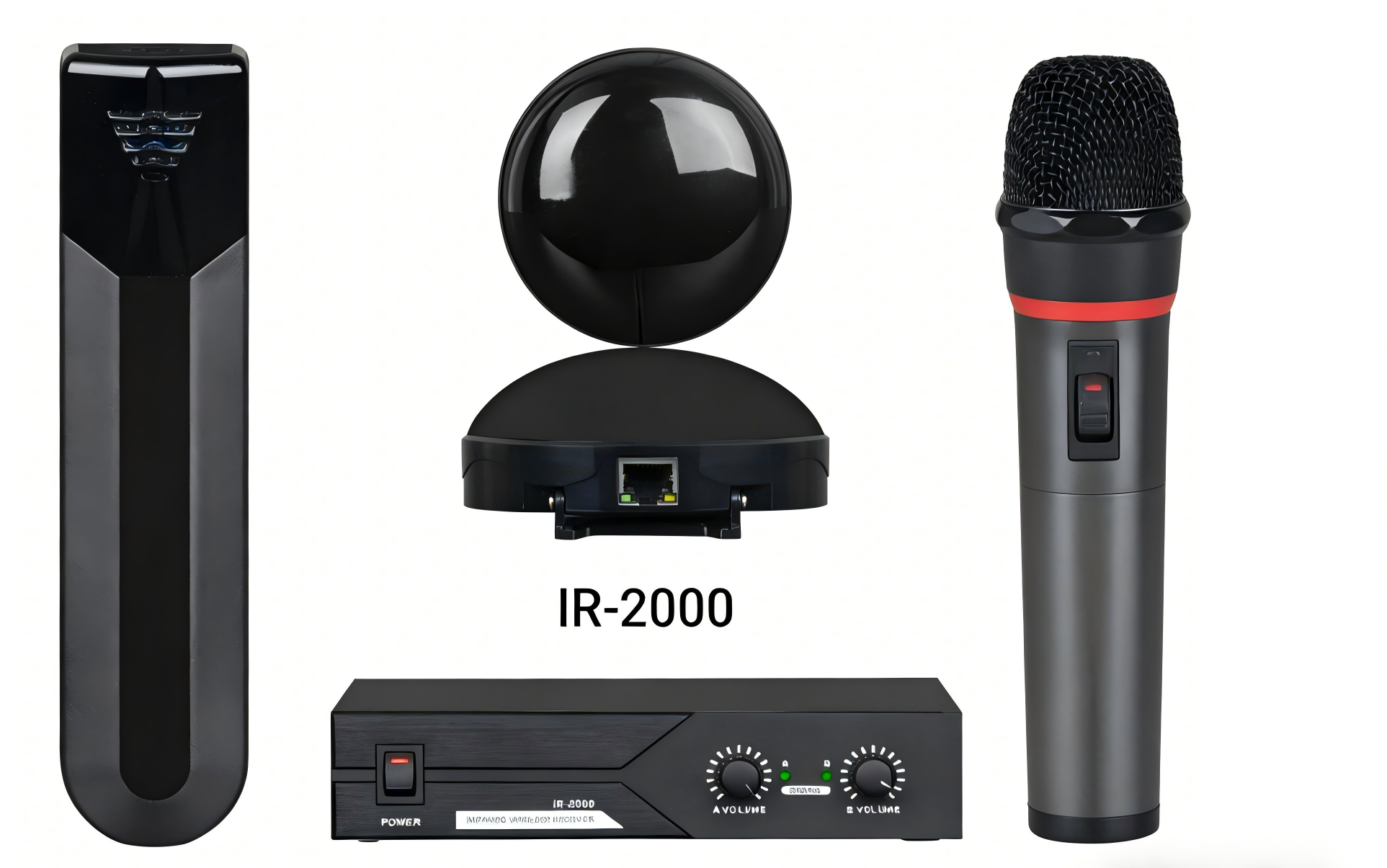
| IR-2000 | Dual-channel infrared wireless receiver | Automatic 2.06/2.56MHz selection, Cat5e runs up to 100 m, 850nm wavelength, no RF radiation |
| IR-300H | Professional infrared handheld microphone | 850nm transmission, A/B dual channel against crosstalk, large dynamic cartridge, 2.5 h charge and 6 h runtime with the CD-4 dock |
| CD-4 | Desktop four-channel charging dock | Four independent channels, Type-C 65W input, two microphone bays plus two 18650 slots |
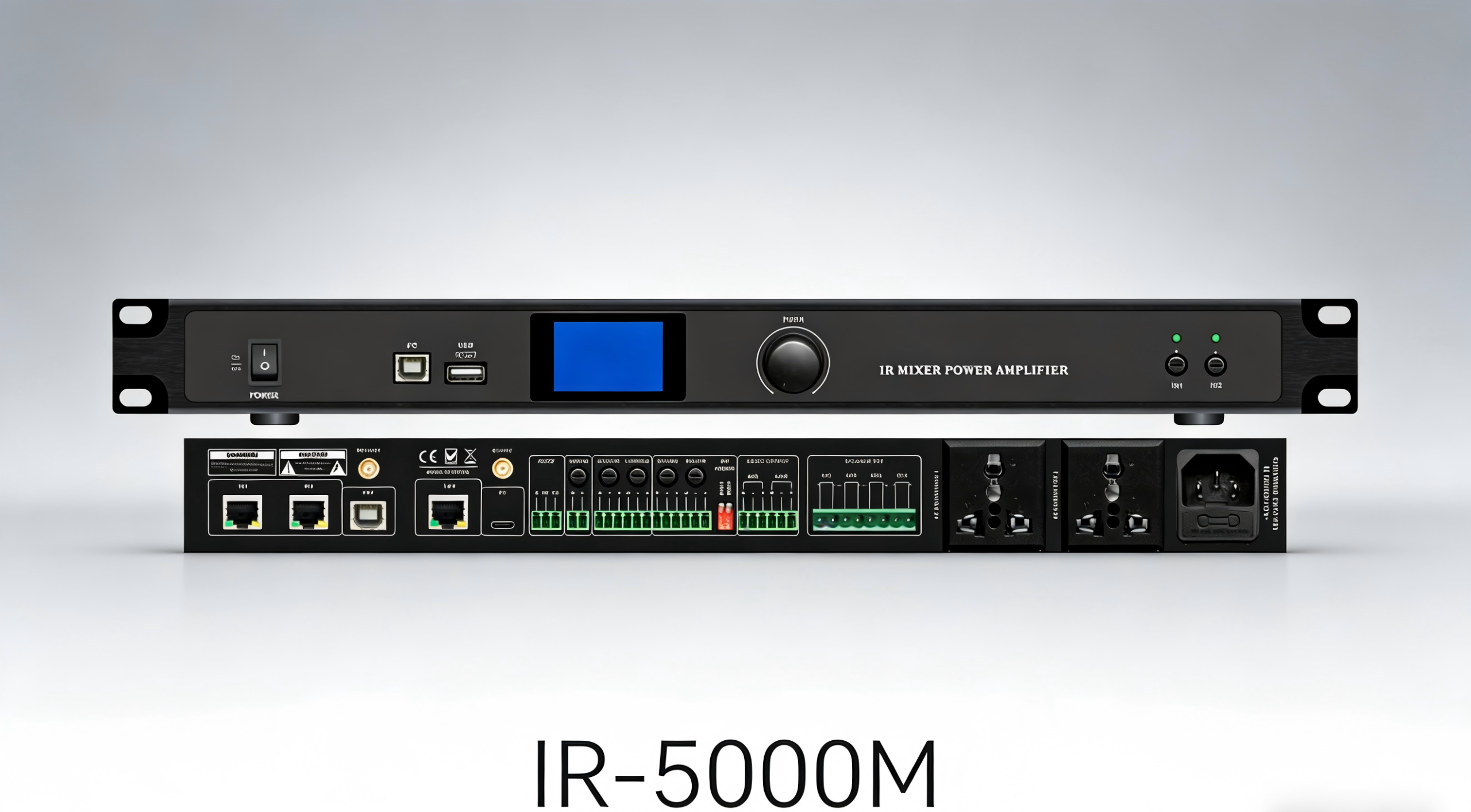
The value of the range is that it scales. A single classroom running two channels and a whole floor sharing one amplifier with sensors zoned across rooms sit on the same protocol and the same technical foundation.
5. A Closing Note
Growth in the components industry eventually lands as a better experience in a specific room. For education audio the real dividing line is whether a teacher wants to switch the system on every day. A system that howls, suffers crosstalk and needs constant retuning will be left switched off, whatever its specification says.