

I Still Remember How Awkward That Lesson Was
In the autumn of 2018 I was doing an after-sales visit at a secondary school. I had barely reached the third-floor corridor when I heard something strange coming out of a Year 9 classroom. The maths teacher was halfway through a lesson on functions, and the loudspeaker kept cutting in with fragments of "Lesson Five" from the English listening exercise next door.
The teacher went red. He pulled the battery out of the microphone and put it back — nothing. Switched off and on again — still bleeding through. In the end he simply raised his voice and talked his way through the second half of the lesson.
We later traced it to two Bluetooth amplifiers that had landed on the same channel. On 2.4GHz there were Wi-Fi routers, students' smartwatches, wireless casting in the next room — dozens of devices squeezed onto one narrow bridge. Crosstalk was not a fault. It was a matter of probability.
That moment settled something for me. Haixin has been building classroom audio for fifteen years, from analogue infrared to digital, and we have never used Bluetooth. Not out of technical purism, but because we had understood what a classroom actually is.
Five Ways Bluetooth Does Not Fit a Classroom
A classroom is not a living room
Bluetooth works perfectly well in headphones and portable speakers. Live sound reinforcement, however, is well beyond what it was designed for.
Latency is the deal-breaker
Standard Bluetooth audio coding introduces around 200ms of delay, and even low-latency profiles typically exceed 35ms. The human ear resolves arrival differences of roughly 30ms, beyond which the Haas effect takes over. The teacher's mouth forms a word and the loudspeaker delivers it a beat later, so students hear a doubled sound.
Listening to that is like watching a badly dubbed film. Ten minutes is enough to make your head swim.
The audio ceiling is low
Bluetooth audio profiles were originally designed for telephony, and the frequency response usually stops around 10kHz. The upper harmonics and the consonant detail that carry speech intelligibility get cut off entirely.
A teacher's voice is transmitting information, not providing background music. Muffled audio directly costs students attention.
Passing through walls is a liability, not a feature
Bluetooth penetrates walls, which means a teacher who forgets to switch off the microphone after class can broadcast a corridor or staff room conversation live. Education settings are far more sensitive about privacy than a home.
2.4GHz is a congested road
Bluetooth, Wi-Fi, wireless keyboards and mice, even microwave ovens all crowd into the 2.4GHz ISM band. When dozens of classrooms in one building teach simultaneously, microphones wandering into each other's space and routers injecting noise are not occasional faults — they are the expected outcome.
The management cost is underestimated
Bluetooth is a point-to-point pairing. A teacher carrying a microphone into another classroom has to pair it again. With fifty teachers and twenty rooms, an IT administrator would spend the day clearing "cannot connect" tickets. The intelligence ends up as friction.

Infrared Was Built for the Classroom
Digital infrared is not the remote control era
When people hear "infrared", they still picture a 1990s remote control that has to be pointed precisely and fails if anything blocks the path. That was analogue infrared. Digital infrared today is a different technology altogether.
It never touches the radio spectrum
Wi-Fi, Bluetooth, mobile base stations, interactive whiteboards: none of them can interfere with it. Nor do the classroom's fluorescent lighting, projectors or electronic ballasts affect digital infrared in any way.
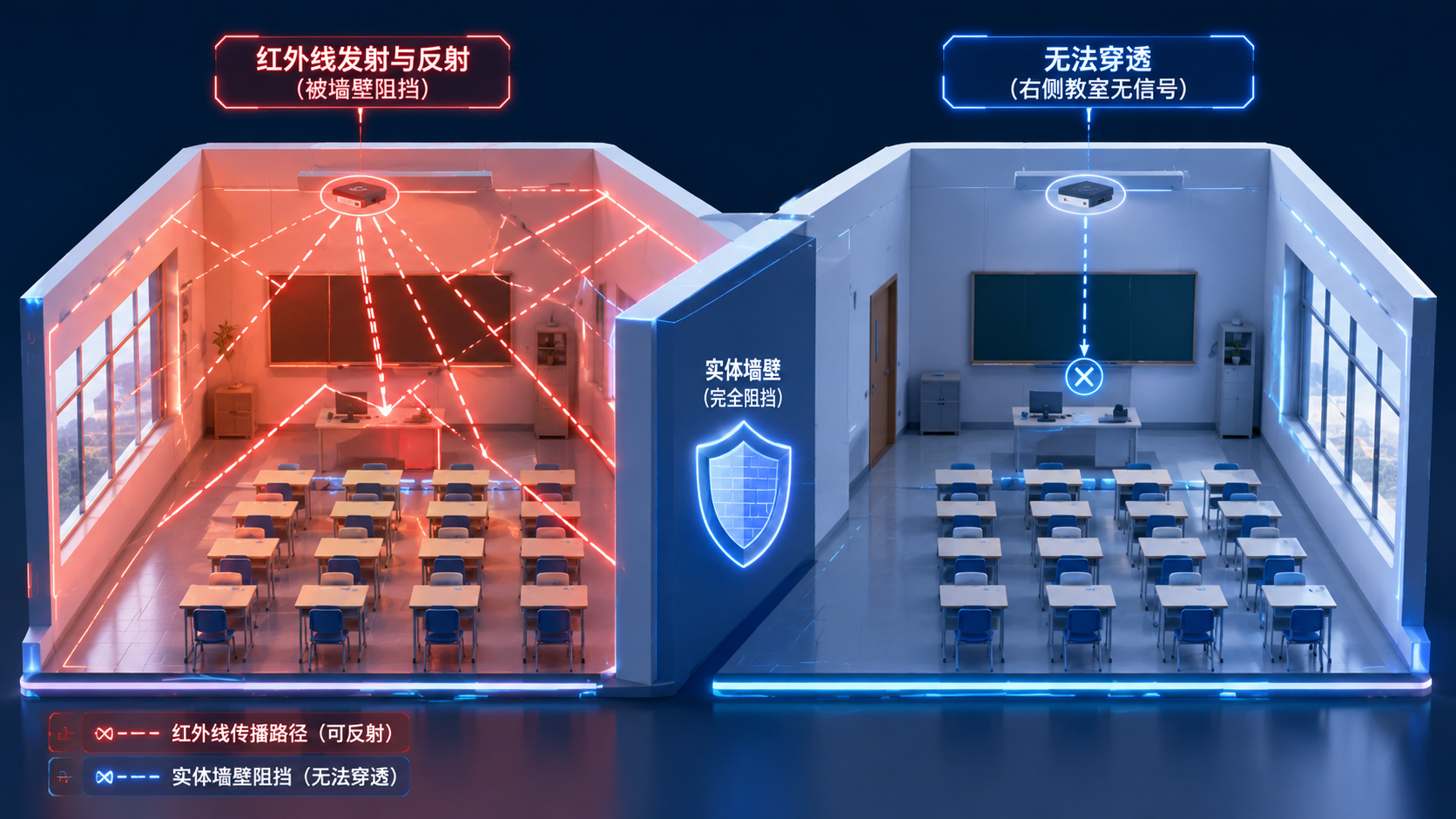
The walls come built in
Infrared light does not pass through walls, so the signal stays strictly inside the room. The microphone next door cannot bleed in however close it gets, and a microphone left on after class cannot be heard in the corridor.
Confidentiality here does not come from an encryption algorithm. It comes from the laws of physics.
It needs no social interaction
A digital infrared microphone works the moment it is switched on. No frequency matching, no pairing. A teacher walks from Room A to Room B, presses power and starts teaching. That zero-friction experience is the real point of teaching efficiency.
No radio-frequency radiation
Wearing an RF transmitter against the body all day makes people uneasy for good reason. Infrared is light, not radio, and produces no radio-frequency radiation harmful to the human body. A teacher wears one for a whole working day, and that is not a detail worth compromising on.
IR-2000: Turning the Physics Into Classroom Experience
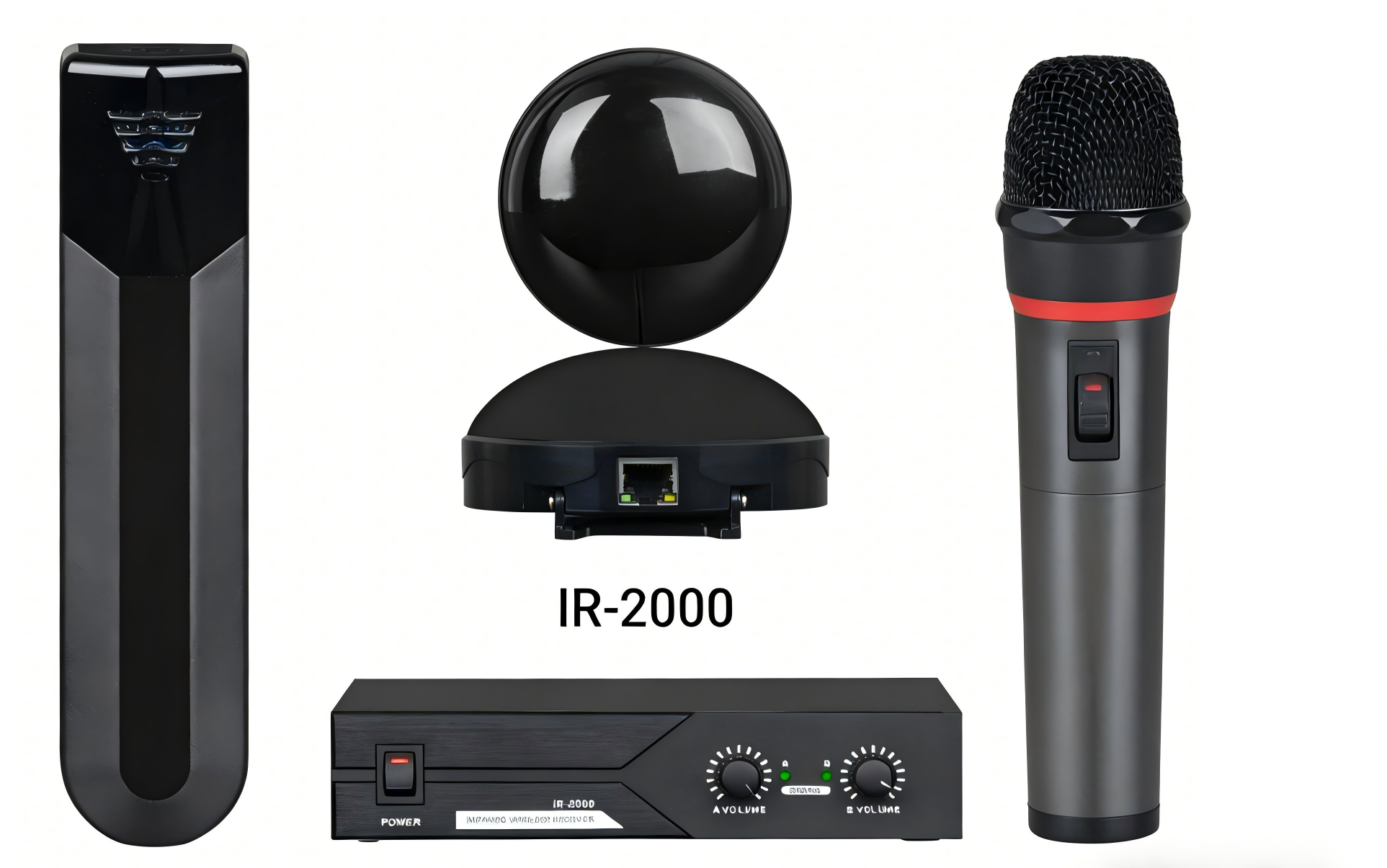
A principle is worth nothing until it reaches a product. The Haixin IR-2000 infrared wireless receiver is our understanding of classroom audio made concrete.
Dual channel, so interaction can happen
One host runs two microphones at once, one for the teacher and one for students, so a question never has to wait for a microphone to be passed. The A and B frequencies sit at 2.06MHz and 2.56MHz and do not collide.
RJ45 networking, no dead zones
External receiver units connect over network cable, up to four sensors per host, each covering a radius of more than 20 metres with 360° reception. Network cable is easier to route than audio cable, so retrofitting an old room needs no wall chasing.
Built-in feedback suppression
As a teacher walks and turns, the changing microphone position invites howling. The IR-2000 catches it at the point of onset, so the lesson is never interrupted by a squeal.
One teacher, one microphone
Each teacher gets a personal pen-style IR-500PT or handheld IR-100H, keeps it and charges it themselves. The school needs no one to hand out, collect and sanitise equipment, and the management cost drops visibly.
Compatible with existing audio
Whether the room runs a constant-voltage amplifier, powered speakers or a line array column, the IR-2000 outputs a standard 350mV line signal that connects straight in. A retrofit is not a rebuild.
Light enough to forget
The pen-style microphone weighs 67g and can be worn on a neck strap or clipped on. Writing on the board one-handed or turning to face the class, a teacher never notices it is there.
In Closing: Bluetooth Is Not Bad, Classrooms Are Just Particular
I have never denied Bluetooth's success in consumer electronics. But education equipment follows one hard rule: stability comes before feature count, and ease of management comes before impressive specifications.
A classroom is a peculiar electromagnetic environment — dense, multi-user, high-interference, and in use for long stretches. Bluetooth was designed for the flexible connection of personal devices. Digital infrared was designed for reliable audio inside an enclosed space. Different target scenarios, so different technical paths.
Haixin stays on the infrared path not out of conservatism, but because we understood what a classroom actually needs. What students hear should be exactly what the teacher said — no more, no less, no earlier, no later, no further, no closer.
